

The whole idea
You move the file. Your client hears about it.
Your workspace
Your client
Inbox โ nothing to chase
Sent automatically
Navoqo
Your file moved to In review
Next: final checks, usually 2โ3 days. Nothing needed from you.
View statusHow It Works
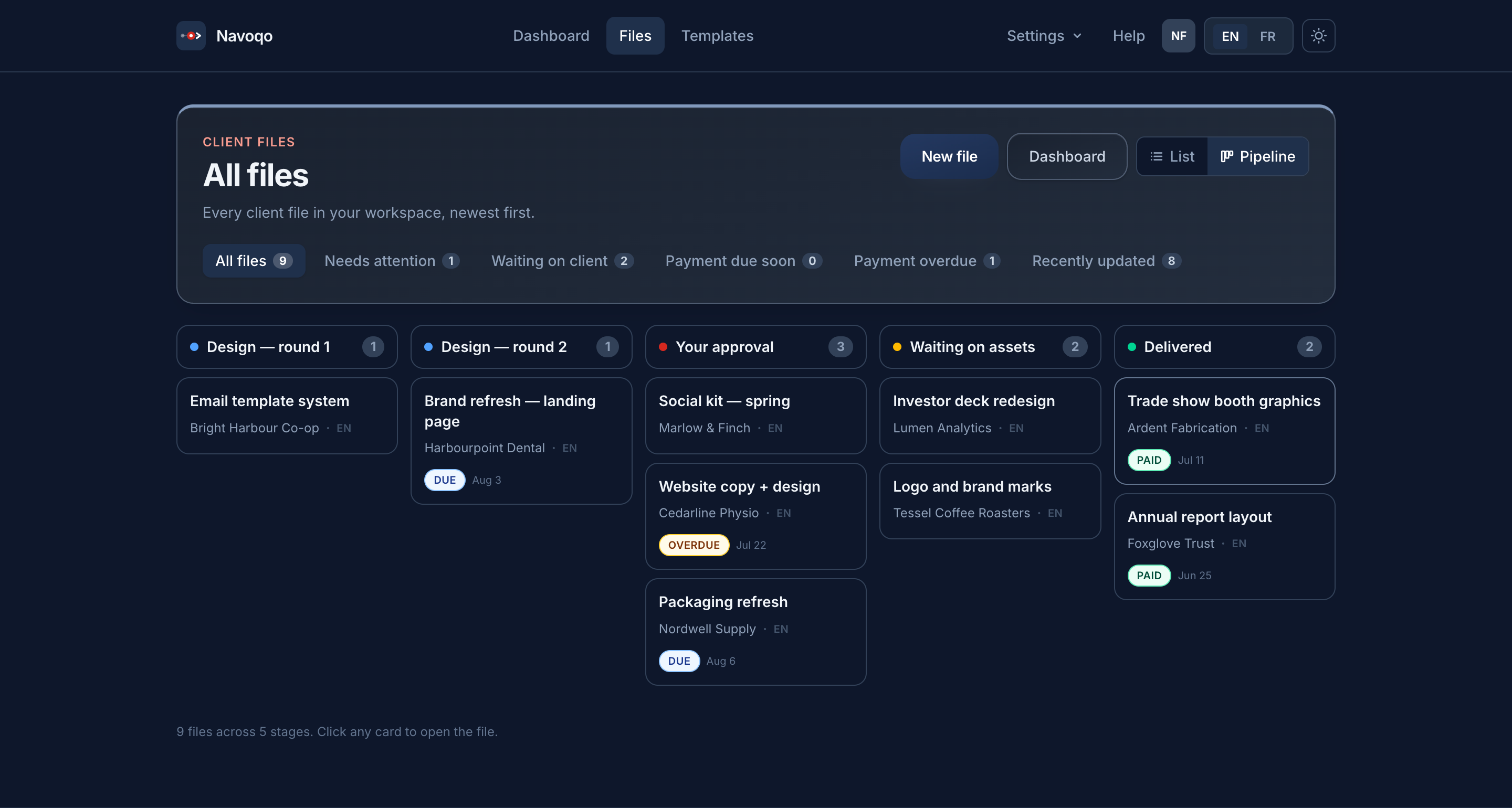
Set your stages once. From then on, moving a file to its next stage sends the client's update, refreshes their status page, and runs the payment reminders โ without you writing anything.
The whole idea
You move the file. Your client hears about it.
Your workspace
Your client
Inbox โ nothing to chase
Sent automatically
Navoqo
Your file moved to In review
Next: final checks, usually 2โ3 days. Nothing needed from you.
View statusWhat changes
Not a longer feature list โ three things that are different on a Tuesday afternoon once the workflow is running.
Most status questions exist because the client has no way to check for themselves. Give them one and the questions stop being sent.
Reminders are scheduled when the invoice is raised rather than when it has already gone quiet, so chasing stops being a weekly decision.
Clients cannot judge the technical quality of work they hired you to do. They judge whether they were kept informed โ and that is what ends up in a review or a referral.
Inside Navoqo

Navoqo follows one practical sequence: workspace, workflow, stages, client files, updates, and billing reminders. Three of those you set once and rarely touch again. The other four are the work itself, and they are what your week actually looks like.
Steps 1โ3
Roughly ten minutes in total. Everything here is a decision about structure, and every one of them is reversible โ you are not committing to anything you cannot rename later.
You
Set your workspace name, owner defaults, and service context once.
Your client
Nothing is sent yet โ you are establishing internal structure first.
The workspace is the container everything else lives in: your files, your workflow, your team, and the templates your client messages are built from. Most small firms need exactly one. Create a second only when you genuinely run separate businesses with separate clients โ not for separate service lines, which are better handled as service types on a file.
On screenWorkspace nameDefault ownerTeam defaults
Why it mattersA single workspace prevents fragmented setup across inboxes and spreadsheets.
You
Define one practical path your files follow from intake to completion.
Your client
Clients get a consistent experience because every file follows the same logic.
A workflow is the named sequence a file travels through. The temptation is to build one per client or per service; resist it. One workflow applied to everything is what makes a promised update cadence possible, because you cannot automate a rhythm on top of thirty bespoke processes. Start with the path your most common job already takes in practice, not the one your process document says it takes.
On screenWorkflow nameApplies to
Why it mattersA stable workflow removes ad hoc handling and unclear ownership.
You
Set clear stage labels such as Received, In review, Waiting on client, and Complete.
Your client
Clients see understandable progress labels, not internal jargon.
Three to six stages is the workable range. Below three they carry no information; above six you stop updating them accurately, and a stage list nobody maintains is worse than none because the status you show clients becomes wrong. Include at least one stage that means "waiting on the client" โ separating "we are working on it" from "we are waiting on you" is the single most useful distinction on the board.
On screenStage nameClient-facing labelOrder
Why it mattersStage clarity makes handoffs and status communication consistent.
Steps 4โ7
This is the recurring loop. If it takes more than a minute or two per file, something in the setup above is wrong and worth going back to.
You
Create one structured file with service type, key dates, and payment terms.
Your client
The engagement now lives in one visible operating record.
The file โ not the contact โ is the unit of work. One client with three concurrent jobs gets three files, which is exactly the case a contact-shaped system represents badly. Setting payment terms here rather than at invoicing time is what later lets reminders schedule themselves without a decision from you.
On screenService typeDue dateOwnerPayment terms
Why it mattersOne file per client keeps status, updates, and reminders connected.
You
Change a stage and your team instantly sees what's done and what's next.
Your client
Updates reflect real progress instead of ad hoc status emails.
This is the only routine action in the product, and everything else follows from it. Move the file when the work actually moves, not at the end of the week in a batch โ the stage is what your client will see, so an out-of-date board becomes a misleading status page. The useful habit is checking what has been sitting in one stage too long; that list is where quiet client relationships go wrong.
Why it mattersProgress is always visible โ no one needs to ask.
You
Advancing a stage sends the update. No manual email to write.
Your client
Clients receive a professional update plus a secure read-only status link.
The message is built from your template and the file, so it names the stage, what changed, and what happens next without you composing anything. The link goes to a read-only page for that one file โ no account, no password, nothing for you to administer, and nothing visible from it about any other client. You can review an update before it goes if you would rather not send blind.
On screenTemplateStatus linkSend update
Why it mattersYou keep clients informed without creating more writing overhead.
You
Set due dates and trigger payment reminders from the same workflow.
Your client
Payment follow-up stays connected to active delivery status.
Reminders are scheduled when the invoice is raised rather than when it becomes late, so chasing stops being a weekly decision about who to nag. They cancel automatically the moment the file is marked paid โ which matters more than it sounds, because a reminder for money already sent is the kind of small carelessness clients remember and mention.
On screenAmountDue dateReminder schedule
Why it mattersChasing from the same record means you never chase an invoice already paid.
Want concrete workflow examples by industry? Explore use cases
Team And Client Model
First Week Setup
Set your default workflow stages and team naming conventions.
Create current files and place each case in the right stage.
Run predictable client updates and due-date reminders from each file.
Keep client files, updates, and payment follow-up aligned in one calm operating system.